- The Gen Creative
- Posts
- AI Video Has Changed Marketing Forever — and Standing Out Requires a New Strategy
AI Video Has Changed Marketing Forever — and Standing Out Requires a New Strategy
+ YummyPic Launches AI Food Photography Platform That Turns Basic Dish Photos into Professional Menu Images in 60 Seconds


Eric Verdeyen & Maddy Wong
October 28, 2025
The Gen Creative
Today’s Creative Spark…
AI Video Has Changed Marketing Forever — and Standing Out Requires a New Strategy
YummyPic Launches AI Food Photography Platform That Turns Basic Dish Photos into Professional Menu Images in 60 Seconds
AI-Generated Video Has Gotten Good. Should Designers Try It?
OpenAI To Soon Launch New AI Tool That Can Generate Music
Meta Adds AI Tools to Instagram Stories That Lets You Edit Photos
What if your next viral video, AI-edited photo, or custom soundtrack could be created before most people finish their coffee?
Read time: 9 minutes
Video Marketing

Source: Entrepreneur.com
Summary: AI has made video production accessible to everyone, removing traditional costs, equipment, and time barriers. Now that professional-looking videos can be generated in minutes, marketing is no longer about who can produce the best visuals but who can offer real value and authenticity. As content floods every platform, brands must shift their focus toward human insight, creative storytelling, and genuine audience connection. The future of video marketing belongs to those who use AI to enhance creativity—not replace it.
Five Essential Elements:
AI-Driven Accessibility: Video creation now takes minutes instead of weeks, lowering barriers for all creators.
Content Saturation: With endless videos, attention becomes the scarcest resource in marketing.
Authenticity as Advantage: Genuine storytelling and expertise now outweigh polished production.
Strategic Use of AI: Treat AI tools as creative assistants that need human direction and purpose.
New Creative Rules: The brands that survive will focus on meaning, not just visual perfection.
Published: October 24, 2025
Photography

Source: YummyPic
Summary: YummyPic has launched an AI-powered food photography platform that transforms simple smartphone photos into professional, 4K-quality menu images in under a minute. Designed for restaurants and hospitality brands, the platform removes the need for costly photo shoots while maintaining visual quality for delivery apps like DoorDash, Uber Eats, and Grubhub. With over 127,000 photos created and 2,000 restaurants using the service, YummyPic is helping businesses boost engagement, increase orders, and enhance their brand presentation through fast, accessible AI image generation.
Five Essential Elements:
Instant Image Transformation: Converts basic dish photos into professional 4K visuals in less than 60 seconds.
Simple Workflow: A three-step process—snap, upload, and download—delivers studio-quality results.
Performance Boost: Users report up to 40% higher menu sales and triple social media engagement.
Affordable Access: Flexible, transparent pricing with no subscriptions or hidden fees.
Creative Versatility: Offers 17 photo styles suited for restaurants, agencies, and hospitality brands.
Published: October 27, 2025
Workflow by The Gen Creative
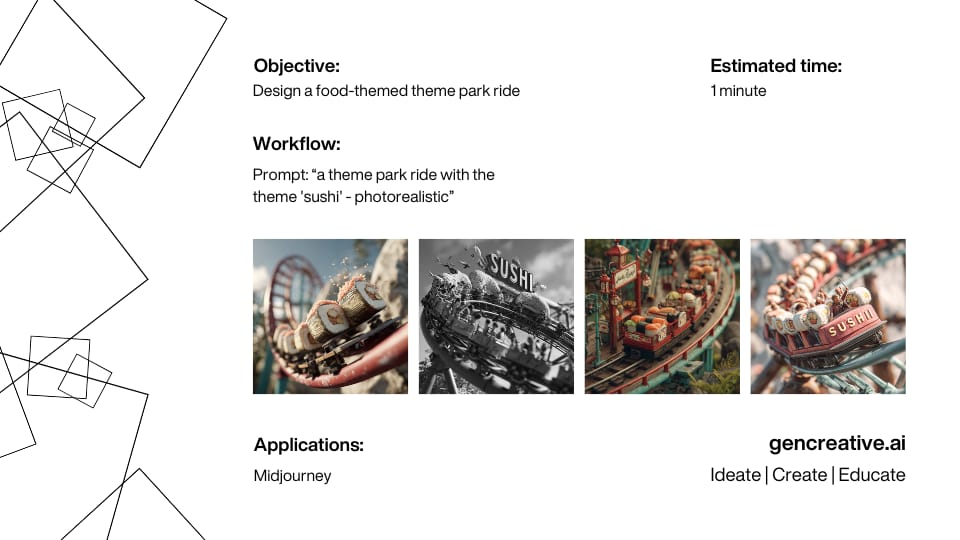
In each newsletter, the Gen Creative team puts together a practical creative workflow so you can get ideas of how to implement AI right away. Want to see more? Check them out here!
Video

Source: ChatGPT
Summary: AI-generated video tools like OpenAI’s Sora 2, Google’s Veo 3.1, and others such as Midjourney and Kling are making it easier and cheaper than ever to produce high-quality, realistic motion content from simple prompts. Designers are starting to explore how these tools can enhance presentations, visualize concepts in motion, and create dynamic social media content. While the technology is still evolving, it’s quickly moving from novelty to practical design aid — helping professionals turn still renderings into immersive walkthroughs and animated storytelling pieces with minimal effort.
Five Essential Elements:
New Generation of AI Video Tools: Platforms like Sora 2 and Veo 3.1 deliver fast, realistic results with simple prompts.
Design Presentation Power: AI can transform still renderings into walkthroughs or lifestyle scenes, bringing design ideas to life.
Concept Exploration: Designers can visualize how people interact with a space before finalizing their designs.
Social Media Advantage: Turning static posts into videos boosts reach and engagement on platforms like Instagram.
From Toy to Tool: Though still early, AI video is poised to become a staple in creative workflows as quality and control improve.
Published: October 24, 2025
Music

Source: NDTV World
Summary: OpenAI is developing a generative music tool that can compose music from text or audio prompts, potentially transforming how creators produce soundtracks and instrumentals. The project builds on earlier models like MuseNet and Jukebox but promises greater control over musical tone, style, and emotion. In collaboration with students from the Juilliard School, OpenAI is training the model to understand musical structure and feeling. While there’s no confirmed release date, the tool is expected to appeal to musicians, filmmakers, and digital creators seeking fast, customizable music generation.
Five Essential Elements:
Generative Music Creation: Produces original music from text or audio inputs.
Juilliard Collaboration: Students assist in annotating scores to train the AI’s musical understanding.
Creative Control: Users can adjust tone, genre, and energy of compositions.
For Creators and Musicians: Designed to help produce custom tracks for videos and projects.
Ethical Questions: Sparks debate around copyright, ownership, and artist compensation.
Published: October 26, 2025
Photography & Social Media

Source: Meta
Summary: Meta has introduced new generative AI tools for Instagram Stories, allowing users to edit photos and videos using simple text prompts. Within the “Restyle” menu, users can type instructions to add, remove, or change elements—like swapping outfits, replacing backgrounds, or applying creative effects such as watercolor or 8-bit. These features bring AI image editing directly into Instagram’s interface, removing the need for separate tools or chatbots. Meta is also experimenting with AI-driven text customization and an “add yours” sticker to encourage creative collaboration among users.
Five Essential Elements:
Prompt-Based Editing: Users can describe what they want to add, remove, or change directly in Stories.
Creative Effects: Presets allow conversion into styles like anime, watercolor, or 8-bit.
Video Integration: Effects like snow or fire can be applied to short clips.
Collaborative Features: “Add yours” stickers let users share prompts and remix content.
Privacy Note: Meta’s AI analyzes uploaded media to generate or modify images.
Published: October 24, 2025
Remote Creative Jobs
5 Remote Startup Creative Jobs
Content Editor – Newsletters: Lead and edit newsletters for Mode Mobile’s 8M+ subscribers.
Learning Designer: Design engaging learning experiences for Angi’s Sales and Care teams.
Multimedia Designer: Create graphics, animations, and videos for KDCI Outsourcing’s digital and social media platforms.
Spring 2026 Internship - Digital Creative: Create digital assets, videos, and web content for BCom’s purpose-driven marketing campaigns.
Performance Creative Designer & Editor: Design paid social ads and motion graphics for Allara.
See you next time!
Big ideas set the path, but small adjustments shape the work. 🌟🎼 AI supports those adjustments—balancing images, smoothing sound, tightening lines. 🖼️🎚️✍️ It stays in the background, quietly helping ideas take form. 📷🎤📑
How did you like it?
We'd love to hear your thoughts on today’s Creative Spark! ✨ Your feedback helps us improve and tailor future newsletters to your interests. 📝 Please take a moment to share your thoughts and let us know what you enjoyed or what we can do better. 💬 Thank you for being a valued reader! 🌟
Keep Reading
Snapchat has made its “Imagine Lens,” the company’s first open prompt AI image-generation Lens, free for all U.S. users, after previously limiting it to paid subscribers. The Lens allows users to edit Snaps or generate new images using custom prompts, such as turning a selfie into an alien or creating a “grumpy cat,” with results shareable to friends, Stories, or beyond the app. The rollout comes amid competition from AI video apps like Meta AI and OpenAI’s Sora, and free users receive a limited number of generations depending on region and capacity. Initially available in the U.S., Snapchat plans to expand to Canada, Great Britain, and Australia. The Lens can be accessed from the front of the in-app Lens Carousel or searched by name, and Snapchat reports Lenses are used over 8 billion times per day, powered by both in-house and third-party AI models.
Instagram has added Meta AI-powered editing tools to Stories, allowing users to modify images and videos using prompts or preset styles. Accessible via the Restyle menu, the tools let users change elements such as subject, lighting, composition, style, or location, and also remove unwanted parts of an image, similar to Google’s Magic Eraser. Users can add or change elements with AI-generated content, like altering hair color or adding balloons, and apply preset themes such as Sketch, 8-bit, Pink, Manga, Watercolor, and Anime. While these features have existed in Meta AI before, this update makes them directly usable within Instagram, with the rollout expected to appear for all users in the coming days.
Facebook has introduced an opt-in AI feature that scans users’ camera rolls to identify hidden or unshared photos, enhance them, and create ready-to-share collages. Meta AI analyzes elements like lighting, people, and events, and can suggest filters, captions, or layouts, all of which users can edit or reject before posting. The feature aims to make sharing easier and give forgotten moments a second life while keeping full control with the user, and Meta says the photos are not used for ad targeting or facial recognition unless shared. Currently available in the U.S. and Canada, the feature requires cloud processing to operate, and users can opt out or delete uploaded photos at any time.